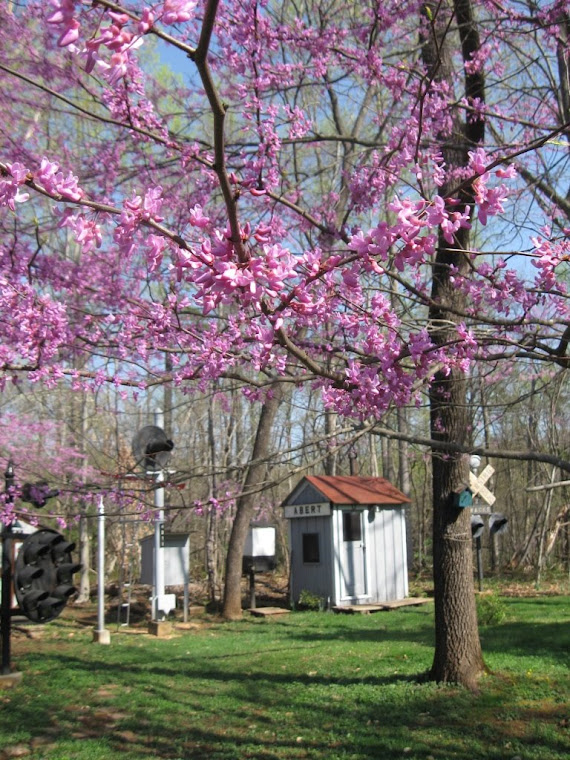
Spring colors frame some of the garden relics

Spring colors frame some of the garden relics

Thursday, January 22, 2015

N&W PL-4 Dwarf Signal


This Norfolk & Western Railway US&S dwarf signal is the first addition to the "Wiley Railroad Relic Garden" in 2015.  This Union Switch & Signal Co. model was first introduced in 1930 and was called a PL-4, "New" model. Dwarf signals were used in railroad yards, as well as to govern certain side tracks and they were far fewer in number than regular, tall signals. 


Signals on the old Norfolk & Western were called "Position Light" signals, meaning the arrangement of the amber lights would display the indication or aspect. All horizontal meant stop; all angled meant a cautionary clear and all vertical meant a clear signal.  There were exceptions to these indications explained in detail in the railroad's rule book. In the late 1950's, N&W started to change from the pure, position light signals to a modification, using colors as well (red, amber and green).  This system was called "Color Position Light." In the early 1960's, N&W started to operate with this new style for its dwarf signals and this is how my dwarf signal is configured.   The signal aspects were as follows.


Green over Red - Rule 287, Slow Clear
Yellow over Red – Rule 288, Slow Approach
Red beside Red - Rule 292, Stop and Stay

When used by the N&W,  it is likely that this dwarf signal was located at HQ Tower, Bluefield, Virginia (milepost 357) to govern train movements against the normal flow of traffic at the faceing point crossover between the mainline tracks there. During it's years of service, tens of thousands of freight trains passed by. 


 In the pictures, it is shown mounted with secured bolts on a concrete pad beside a post displaying an N&W Whistle Post sign and a classification running light from the front of Virginian Railway class MC steam engine 468. As it was when in use by the N&W, the back plate is secured with a heavy brass lock, marked for N&W and an "R" for the division of the location, Radford Division.      ( In the picture showing the front of our home, notice the orange cat sitting in his box on the porch. The picture was made in January and "Buddy" is our outdoor cat. As he has aged, he spends more time with us and his box has a heating pad to keep him warm in cold weather.)


The back is removed, revealing the inside of the signal.

This link is to a 12 second video of the signal illustrating all of its aspects (indications)


https://www.youtube.com/watch?v=oxyZoBYrYTc


N&W Bridge Number Post


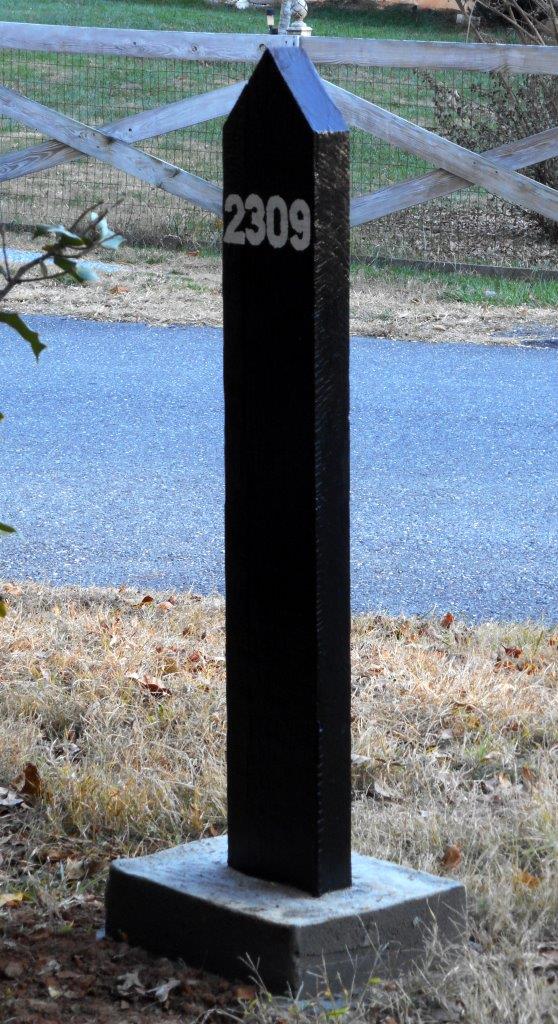
In November 2016 while visiting remaining railroad locations in West Virginia of Norfolk & Western's Bluestone Branch, I noticed a new-to-me relic at Matoaka, a concrete post near the end of the railroad bridge over Left Fork of Widemouth Creek. The weathered post shows the number 2309, which, as I found, is the number of the bridge on N&W track charts. After describing this unusual post with many friends, it seems it likely dates to when this branch was built soon after the turn of the century. I found no reference at all to a bridge number post in the archives of N&W Historical Society.  I have learned from my friends that another bridge number post stands at Montcalm, also on the Bluestone Branch. It seems that these tow posts are the sole survivors. By the way, N&W abandoned most of the branchline in place in 1984.  Unable to find any material whatsoever in the N&W archives, I have made a rough, not to scale drawing,  showing measurements made during examination of the post at Matoaka. (42" above ground, 10" wide and 4" thick)  This photo shows the bridge number post situated 12 feet from the center of the track at Weyanoke, WV. 


~ ~ ~ ~ ~


Inspired by this unusual find, I decided a make a replica of it for our Wiley Railroad Relic Garden. In addition to providing a source for others to study, it serves a useful purpose. I put it at the end of our driveway and it shows the house number on one side and the number on the back is the number of the post that inspired me, number 2309. 

Assistance was given by Jon Charles, Jeff Hawkins and Ken Miller.


Chesapeake & Ohio RailwayStation Scales from Mount Hope, W V 


        This Fairbanks Company station scales was a recent gift from a friend in West Virginia. Having a capacity of half a ton, the scales were last used at Mount Hope on C&O's Loop Creek Branch which extended twelve miles south from the mainline at Thurmond, WV on the New River. 
     One rail historian wrote, "Any station that handled express would need one of these as billing depends on weight and dimension. I am sure the possibility of weighing LCL (less than carload) items and passenger baggage (trunks, etc) would factor in. C&O had a calibration and repair shop at Huntington that handled these system wide and scales rotated from place to place as they were out shopped."  The scales' deck is 17-1/2" by 26-1/2" and the balancing tower reaches 45 inches.

       The 1948 Official Guide for Passenger Trains shows that passenger train service was still available at Mount Hope in 1948. It lists passenger train number 136 leaving the mainline at Turmond at 3:10 pm, making the twelve mile journey up the mountains to Mount Hope, arriving at 4:05 pm. The return train, number 137, left Mount Hope at 4;20, reaching Thurmond at 5:03 pm.  Virginian Railway had branchline passenger and freight service to some of the same line as C&O, but it did not reach Mount Hope. Its closest point was Oak Hill, WV. 

             An inspection date stenciled on the scales is March 1948 and it was performed on site by a C&O railroad inspector. 


We are grateful to the following for their involvement in making this happen. Joe Mackowiak, Jim Wiley and C&O historians Tom Clay, Matt Crouch and Tom Clay. It is pictured above in our Wiley Country Store and Walnut Level Texaco, which are adjacent to the Railroad Relic Garden..


Sunday, October 28, 2012

To reach Aubrey Wiley, email VgnRy43@aol.com


Last Updated October 28, 2012

Saturday, October 27, 2012

West Virginia Logging Camp Relic

While exploring the grades of a logging railroad in West Virginia, I was surprised to find an old camp!  It happened in October 2012. The logging company was last operated in June 1960 and this line, nearly 4800 feet above sea level, saw use sometime prior to that date. Discovered and left in place were numerous glass bottles and jars, ruins of shanties, commercial oil cans and even a rusted through five gal. C&O RR oil can. It must have been "lifted" from the C&O which had a branch line about 10 miles away.  Beside the frame of a bed was a, rotted, moss covered work boot!  One can imagine a wood hick sitting on that bed to either put on or take of his leather work boots and for some reason, leaving this one behind. Perhaps its sole was worn through. In the picture above, a rusty bed spring can be seen between the boot and the bed frame on the left.  In the pictures belw, we may see the second growth of Red Spruce trees growing in the old railroad grade. Along that grade are moss covered cross ties and in one picture, a lone spike stands above the moss.


This old logger's boot is now in the woods adjoining the Relic Garden, resting among ferns near the C&O signal.

Tuesday, July 17, 2012


Southern Railway Signal Finial

Standing 26 inches high and weighing 48 pounds, this cast iron finial adorned the top of a Southern Railway signal which protected a crossing diamond used by N&W and Southern railways in Lynchburg, Va. The structure was Union Station and in its heyday, it saw passenger trains of the Southern, Norfolk & Western and Chesapeake & Ohio railroads. Until December 1941, Lynchburg Traction & Light Company's street cars also called at the station on a street to the right and above the Southern track in the picture. In the larger vintage picture from 1956, N&W's westbound Powhatan Arrow passenger train is loading passengers at the station while a brace of Southern diesel switch engines wait in advance of the aforementioned signal. The Southern train will proceed once the N&W passenger train leaves and the signal gives a proceed indication. The Southern train is inside a short tunnel that passed under Ninth Street.

Saturday, February 4, 2012

N&W Shop Made Dwarf


Shaffers Crossing Yard in Roanoke has long been a major marshal ling yard for Norfolk & Western Ry. At the west end of the yard is N&W's locomotive shop which had a 40 stall roundhouse in steam engine years. Two mainline-looking tracks curved around the roundhouse on the north side: They were called the "eastbound and westbound running tracks." Starting as a teenager in the 1950's, I went to Roanoke with my father as he worked from time to time and I always spent a few hours on an overhead foot bridge that spanned about a third of the east end of Shaffers Crossing yard on the north side. The bridge was used by railroad men to reach their jobs from Shenandoah Avenue. I appreciated the large N&W steam engines that were relegated to yard service with the coming of diesel locomotives and a highlight was to see the eastbound passenger train, "The Tennessean," a joint Southern and N&W train, as it passed beneath me on the eastbound running track. Just a short distance west of my vantage point was a small dwarf signal, informally called the "Eastbound Running Signal 18" because it was between 17th and 18th streets. The signal was a home made signal from the shops, just a pair of old PL-1 light cases from an N&W position light signal some place. The light cases were mounted one above the other and only gave two indications; "Approach" and "Stop." Authority for the running tacks did not come from the dispatcher or from the yard master but from switch tenders who worked at each end of the running tracks. And they were pretty much "automatic block" signals. The practice seemed dangerous and vague, but it worked. In 1970, the dwarf signal was taken out of service and replaced by a traditional mast mounted color position light signal.
I am grateful to Ben Blevins, Abram Burnett and Harry Bundy for their roles in making this signal a part of our Railroad Relic Garden.

Tuesday, January 17, 2012

VIRGINIAN Ry Train Order Semaphore


I obtained another rare piece of Virginian Railway history when I received the GRS type - 2A Train Order Spectacle and Blade. I am told it came from the Virginian's Salem, Virginia station, milepost 251, when it was demolished in the 1970's. The spectacle is cast iron and weighs 85 pounds. In some pictures it appears it was made for four colored lens to give four indications. Actually, the last hole was for another weight to be added if necessary. On mine, the additional weight was not in place and the hole was covered with a thick sheet metal plate. The blade is wood and black on its back side. Assembled, all pieces were six feet in length and weigh 90 pounds, making it a difficult item to lift up a tall pole. Mine is mounted on a wall inside our home in a room decorated to represent the office for an agent-operator at "SA" Salem, Va. The picture shows it in use as a westbound freight train passes the station in November 1959.

VIRGINIAN Ry Caboose Stove


Weighing a few hundred pounds, this cast iron stove was used in a Virginian Railway wood caboose of the C-1 class and built between 1906 and 1924. The donor caboose had been purchased from the N&W in 1960, a year after the VGN/N&W merger, and placed beside a private lake in Nottoway County, Virginia. After arriving at our Relic Garden in 2011, it has been repaired, cleaned and treated so it can continue to be useful for many more decades. It addition to cooking outdoor meals it is used by Charlotte as a wood fired kiln for her pottery work.

Wednesday, July 13, 2011

Virginian Motor Car Restoration


In July 2011 the restoration of my ninety year old Virginian Sheffield motor car 109 was completed. The car was carefully cleaned by hand sanding, electric sanding, chemical paint remover and sand blasting using tiny iron ore particles and coal dust. And every hour of it was pure pleasure. As I went through layers of paint I learned much of the car's history, eventually realizing that the car was originally orange. It was verified by former Virginian employees. In researching Virginian's motor cars I found that my car was built in 1921 and assigned to Victoria, Virginia, a major yard and division headquarters. Its original number was 905. I have made another blog about the restoration work itself with far more detailed information.
http://vgn109.blogspot.com/

The 109 is shown fully equipped and ready for a day's work. In the front, from left; the red tube contains flares and flags for safety needs, an iron milk crate which was used by many maintainers to transport their tools in the car, a bag containing a portable field telephone, an aluminum lunch bucket and a canvas pouch that held paper documents required by the railroad (current rule book, current employee timetable, various safety papers and a lineup of the day's train activities obtained at the start of the day from the dispatcher and updated during the day).


The Motor Car Shed (Tool House)  is a 2/3 scale replica of the company's one car shed.  In addition to providing a secure home for the motor car 109, it also displays tools and equipment used by Virginian Signal Maintainers. Tools are arranged on shelves and hung on side walls as they were in actual motor car sheds. On the rear wall, there are two water tanks, as described by George Lewis, a Virginian Signal Maintainer. The round tank was insulated and held cool, iced drinking water. The rectangular tank held water for washing while below was a bucket to catch wash water.


Tuesday, March 8, 2011

Circle Garden Entrance of Railroad Posts


Behind the whistle posts of Virginian Railway, left, and Chesapeake & Ohio Railway, right, is the walkway made of old paving bricks leading into our small boxwood garden, the Circle Garden. Flanking the walkway are a Virginian Clearance Post, left, and a C&O Right of Way marker on the right. March 2011

VIRGINIAN Ry Clearance Post - "100 - Car Post"


Virginian had "Clearance Posts" also known as "100 - Car Posts" located 4580 feet beyond the ends of passing sidings. The purpose was to inform an engineer of when a 100 car length train was clear the switch of a passing track so the train could be operated at mainline speed according to rules. They were located between nine to twelve feet from the center of the track on the right side, the engineer's side, for right hand running. Generally, passing sidings were on the north side of the east - west railroad and eastbound trains had priority. In early years the posts were made of Chestnut but as that wood became scarce in the 1930's, concrete became the material of choice. They were 6 inches square with the corners having a 1" by 1" chamfer. The top featured a point made by 30 degree angles. The posts were six and a half feet long with four feet being out of the ground. Although company drawings called for the lower two feet above ground to be painted black and the remaining top to be painted white, the paint soon wore off and the posts were left looking a natural concrete color. - Information Source: Virginian Company drawing D-18, 10/10/27, revised 7/20/45

Thursday, February 24, 2011

Railroad Line Pole


We needed a better outdoor clothes line so I put my mind to the task. I remembered how good Ben Blevins' line pole looked so the idea was born and the solution became clear. After looking for a used pole w/o success and learning how expensive a new one was, my son Jim told me about a place where I could get a locust pole. I decided to just walk back into our woods and see what I could find. The result is this nice pole that is actually a limb broken off a very large oak in June 2010 in a severe windstorm.

The cross arms are from "field trips" over the decades as are the insulators. Ben Blevins (N&W), Landon Gregory (VGN) and Bud Huff (C&O) gave me suggestions for the placement of the different colors of insulators. On the lower arm, left end, there are the metal letters "440 olts." The v was missed when I got the letters from a discarded C&O pole. The insulators above the letters are brown and indicate the placement for 440 volts the railroads carried to power remote stations and shanties not served by public electricity. The center green ones are for the railroad's message line and the clear ones on the right are for the dispatcher's line. On the top arm, the two white ones on the right are for railroad telegraph and Western Union. Telegraph operation used the earth as the ground. The two green insulators on the left are "not in use" and the one with copper wire still around it was found that way by a C&O signalman many yeras ago and given to me.

Only three lines will be attached with the other ends going to the Texaco Gas Station/Country Store replica nearby. The lines can be lowered for loading and then raised up out of the way. February/March 2011

Wednesday, January 19, 2011

N&W High Voltage & Close Clearance Signs


Running beside N&W's right of way were poles carrying wires for communication and signal control. This thin, tin sign was about milepost 197.5 on the abandoned, old mainline west of Concord, Va. and warned of high voltage wires above. January 2011

At a freight house in Appomattox County on the abandoned old N&W mainline around Lynchburg, this sign was once used. It is baked enamel and warned railroad workers that the clearance between the structure and a freight car was not sufficient for a man to pass. March 2012

Thursday, December 23, 2010

N&W Cast Iron Sign


In the 1920's and 1930's Norfolk & Western cast these heavy signs in the railroad's Roanoke Shops. Made of scrap iron it has far less the ingredients it should have to make it a strong piece of cast iron, but it was inexpensive to make. This 55 pound sign was a gift and I was told by the donor that it came from N&W's Bluestone Branch which was a coal mine branch of about twenty miles, reaching from the mainline at Bluestone to a connection with the Virginian Railway at Matoaka and on to Giatto. My sign had been broken many years ago and repaired by the railroad by bolting a piece of iron across the top on the back side. I had it welded on the back by a skilled craftsman and I chose to not sand it clean and repaint it to new condition. I feel the crack in the cast iron and the peeled paint attest to the age and character of the piece. November 2010


Saturday, June 26, 2010

VIRGINIAN RAILWAY Speed Limit Sign


Virginian had signs informing speed restrictions at many locations, but most were found at tight curves. These orange/yellow signs saying a speed limit were placed 200 yards in advance of the restricted speed area where another sign with the actual "SLOW" sign was placed. On the far side of the restricted speed area, another sign was placed, green sign with white lettering, "RESUME SPEED." This side of the speed limit sign is restored while the reverse side is left untouched and the lettering is in very poor condition. Rather than destroy what little remained on both sides of the sign, I chose to restore one side.

Friday, June 25, 2010

VIRGINIAN Steam Locomotive Firebricks


Arranged in a row in our fern garden, near the collection of other railroad relics, are four large boiler fire bricks discarded by the Virginian Railway shop force in Victoria, Virginia in 1959. The writing cast into it reads, "American Arch Security Company." Future research may provide more information. They are the gifts of Greg Elam and Edwin Massie, both of Victoria, who told me they were intended for the railroad's 500 (BA class) or 900 ( AG class) locomotives, when needed.

C&O Fire Hydrant


Gladstone, Virginia was an important crew change point on the C&O's James River subdivision until about 1985. In its hey-day, Gladstone had a yard, roundhouse with a turntable, steam engine service facilities, car repair area, coal and water facilities for steam locomotives and a large wood, two story station. A YMCA was there for the train crews to have their rest. In the 21st century, all that remains are the two story station and part of the yard. All through the railroad yard there were railroad installed and maintained fire hydrants. In the spring of 2010, I was given the fire plug that was behind the roundhouse.

This fire hydrant was manufactured by Eddy Valve Company in the early 20th century and is a short barrel, dry barrel type. It has two 2-1/2" outlets which would serve 250 gallons of water a minute, each. The color of the bonnet tells that it sat on a 12" main water line which could furnish 1,000 gallons per minute. The railroads huge water tank was close, only about 50 yards away, so that explains the ample water flow available. This information was provided by Capt. John Spinner of the Lynchburg Fire department.

C&O SIgn for Pearch, Virginia


Pearch was located on the James River subdivision of the C&O Ry at milepost 161.3, 13 miles west of Lynchburg, Virginia. In the mid 1970's a C&O coal train derailed at PEARCH, dislodging this sign. The railroad cleanup crew discarded it, and gave it to me. It sits atop its original 6/6 wood post just a few yards from the C&O signal.
Pearch was originally called Pedlar's but it was changed to Pearch in the early years of the 20th century. The original name probably came from the fact of the confluence of the James and Pedlar rivers being just to the east. In its hey-day, apples and timber were shipped as well as grain mill products. In addition to the mill there was also a combination store, agent's office and telegraph office, all in one structure. In addition to the C&O railroad, Pearch was connected to the outside world by a gravel road to the east to Holmcomb Rock, running close beside the C&O right of way. From the late 1800's into the early 1900's, a cable ferry crossed the James River to Amherst County. The lumber probably was produced on the Bedford County side of the river and the grain and apples came from across the river in Amherst County.

N&W Switch Point for Yard Crews


Until the 1970's, N&W had a very active yard on an island in the James River at Lynchburg and just beyond the west end of the island were connections with Southern and C&O railroads. This piece of rail, about 70 pounds per yard I estimate, was placed vertical along one of the through tracks so that an engineer would know his train of a certain amount of cars had cleared a point.